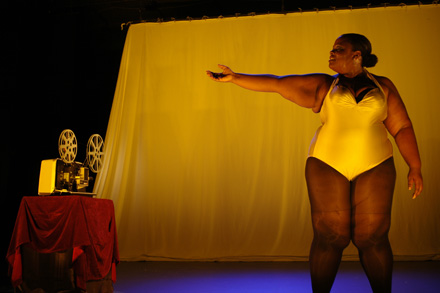
The artworks inside include a giant sculpture of a black Chanel handbag that encases a video. By Swiss artist Sylvie Fleury:
 If, Postmasters, New York by Herve Mikaeloff, 1992 PETER: Were you thinking about the idea of the readymade?
SYLVIE: Yes, but the readymade had been done so much already. There was no point in just redoing a readymade. I liked the idea that the work could be completely superficial. There was also the idea of seduction, the idea of brands, names, labels, and all this stuff that was very present in the late ’80s. I also liked that the work was abstract, in that when you looked at the shopping bags, their contents were hidden and you couldn’t quite know what was in them.
 Don't do it ! (Readymades of the 20th Century),
John Armleder, 1997-2000, Mixed media
SHADOWS, REFLECTIONS AND ALL THAT SORT OF THING #50, 2010
c-print, Diasec, 125 x 100 cm, ed. 6 'Places are both the topos for a given event but also the sign, the tropos for the recollection of the path to another place and time'. Nikos Papastergiadis
Sculpture for Traveling, Duchamp, 1918
 |
| Original version (as included in The Box in a Valise), 1918 |
| Original Version: 1918, New York
lost
rubber strips cemented together and strung up
readymade?
dimensions vary (flexible construction) |
http://www.toutfait.com/unmaking_the_museum/Sculpture%20for%20Travelling.html
This soft sculpture Readymade is made of different colored rubber strips cut from bathing caps. Duchamp cemented these pieces together at random intersections and tied the whole construction up with strings attached to the corners of his studio at 33 West 67th Street, New York. In a letter to Jean Crotti on July 8, 1918, Duchamp described this piece as "a kind of spider's web made up from all the colours" (Ramirez 44).
Sculpture for Traveling embodies the souvenir concept. In 1966, Duchamp called it a type of "voyage sculpture" (Cabanne 59). In fact, it was literally intended for traveling and could be recreated "out of his suitcase at every stop on trip from New York to Buenos Aires in 1918" (Ades 159). Duchamp described this Readymade in the following manner in a 1966 interview:
 |
Original version (photograph), 1918
"1917" date inscribed appears incorrect |
| "Naturally, they took up a whole room. Generally, they were pieces of rubber shower caps, which I cut up and glued together and which had no special shape. At the end of each piece there were strings that one attached to the four corners of the room. Then, when one came in the room, one couldn't walk around, because of the strings! The length of the strings could be varied; the form was ad libitum. That's what interested me. This game lasted three or four years, but the rubber rotted, and it disappeared" (Cabanne 59-60). |
Treatise on NavigationUnder the cultural rain(Althusser, Duchamp, and the use of Artistic Forms) pg 143
Bourriaud says we perceive culture as a product(merchandise), distributed by institutions and businesses--
*we are bombarded with so many visual signs every day-- what to do under this "rain" of influences? pg 143 Althusser's essay "The Underground Current of the Materialism of the Encounter" uses the rain metaphor to describe atomic structure of reality and Bourriaud uses this to support his strategy--
Cultural Production as precipitation--
" this rain of cultural objects hollows out crevices and modifies the contours and natural lines of human society. Its total mass is one thing; its individual atoms(that is, this or that particular work) are another).so each the metaphor continues on with meaning of the work of art has value in itself depending on where its going-- its context
Bourriaud says Althussers philosophy is given through the lens of Marx given through the lens of Hegel-- this makes for an incompatibility with its true nature
-- do we also see Duchamps work through a lens that renders our system of thought incompatible with his?
Appropriation and Neo-Liberalism
here we go... can of worms.
Appropriation. pg 145 Archetype ; buzzword of white critics--
Picasso-- recycling approach resurecting history-- "tracing a line" from his art back through history.
Doesn't a work of art, made now, even if it's an exact replica, a reference to a piece already done or a readymade object, say something new because of the artists intention? Even as an homage it still has its own voice because of time and place; because of "cultural rain"?
As Bourriad said on pg 144- " the work of art is a locus with its particular haesseity, its specific and concrete situation...".
**The locus of something is the place where it happens or the most important area or point with which it is associated. **| Noun | 1. | haecceity - the essence that makes something the kind of thing it is and makes it different from any otheressence, heart and soul, inwardness, nitty-gritty, pith, substance, gist, kernel, nub, meat, core, sum, marrow, heart, center, centre - the choicest or most essential or most vital part of some idea or experience; "the gist of the prosecutor's argument"; "the heart and soul of the Republican Party"; "the nub of the story" |
I think our relationship to history has a sense of ambiguity that make any creative happening in the now its own force.
Example 1; Marcel Duchamp, Bicycle Wheel(1913)pg 146 "The invention ( I say discovery) of the readymade represents a tipping point in the history of art...with this radical gesture of presenting an everyday object of comsumption as a work of art.." the whole reality of how we perceive what art is was upset...
DUCHAMP didn't use the word
appropriation .
1st Point He thinks of notion of choice rather than production-- pg 147-- Duchamp says when you make a painting you choose the colors the canvas the subject-- everything. "There isn't any art; it's a choice.. There (with the readymade) it's the same thing. It's a choice of object.
Bourriaus says, "the act of choosing is by no means equivalent to that of appropriating..." pg 147
Appropriation-- taking object
Readymade-- new meaning to object
2nd point- beauty of indifference I LOVE this idea-- choosing something without considering whether you like or dislike it--
I am trying to understand how this connects-- Bourriaud talks about Wu Wei-- taoist principle of non-action, and the Buddist idea of impermanence-- I LOVE these concepts and I have a dim lightbulb glowing trying to understand the readymade connection-- READYMADE-- object is of no importance, can be replaced or not-- ok-- non action and impermanence-- a spiritual path the letting life flow-- getting out of the way. Hard to see the connection for me, because I personally want to feel warmth toward what I am making, or why bother. I am missing the point I think.
pg 148 Bourriad says "an indifferent object is not something to be appropriated, on the contrary, in the readymade, Duchamp finds an easthetic formula for dispossession. " ok I hear it but I still don't see it.
3rd Point Idea of Displacement Pg 148 The readymade needs to be displayed for effectiveness. Registered by gallery or camera, ratifying in Duchamp's terms the "absolute contradiction" --readymade belongs to no particular domain.
50 yrs later-- Critic Beuys sees nothing but appropriation in the readymade. he feels by Duchamp signing the urinal it expropriates the labor of the workers who worked in kaolin mines.. Bulldonkey! Intention... Context
in Art & Today, pg 40, "Art resides not in the object itself, but in the meaning we embed in it." I agree!
Example 2 Marcel Duchamp LHOOQ
mustache on the Mona Lisa-- prankster wit-- te he he Pg 149 Bourriaud says aim is to desacralize or trivialize cultural icon-- I like this idea, "breaking the chain of what could be called cultural attachment-- as what Witold Gombrowicz in his Polish Memories describes as "gaping mouths" and "vacant gazes" crowding around that very same Mona Lisa. These people are not apreciating or evaluating; they are obeying a cultural imperative." YES! I say.
The SI-- detournment--a distortment( hijacking, rerouting, misappropiation, derailment) of preexisting aesthetic elements. Debord can not jive with the idea of "citing without quotation marks, without stating the source, and with the aim of deliberately transforming it--" pg 150
SI inagural statement--There can be no situationist painting or music, but only a situationist use of those means" --give me a break please
contemporary detourment-- the logo, acronyms, and slogans
the "Peter Principle"-- we can't conceive of manipulating objects beyond certain limits-- interesting pg 152/3
Interform

 Cindy Sherman, Untitled #186 & #187 1989
 Jeff Koons - Ilona on Top (1990)
 Barbara Kruger
 Adrian Piper, Everything #10